
Mind the gap before the smartphone: almost half a million families are waiting to give their children a phone, without a real alternative
In more than 20 countries, parent movements are organising almost half a million families who are waiting to give their children a smartphone. Nearly all of these countries now ban phones in school, but only four countries give guidelines on when a child should own one. And no movement says how the child should reach their friends in the meantime. That is the gap Barnluren fills.
By Barnluren
Photo: Claudio Schwarz / Unsplash
In November 2022 a parent in Poblenou in Barcelona started a WhatsApp group. The idea was simple: if enough families in the same class promise each other to wait with the first smartphone, nobody has to be the only one without.
Four years later the same idea exists in at least twenty European countries. We have mapped them, country by country, together with the legislation that has grown up alongside. Two things surprised us. The first is that Britain's Smartphone Free Childhood, usually presented as the movement's origin, is second to last among the big ones. The second is that legislators and parents are pulling in different directions: the states regulate the school day, the parents regulate the pocket. And the mechanism itself, a promise that only counts once enough families have signed, is not European at all. It comes from Texas.
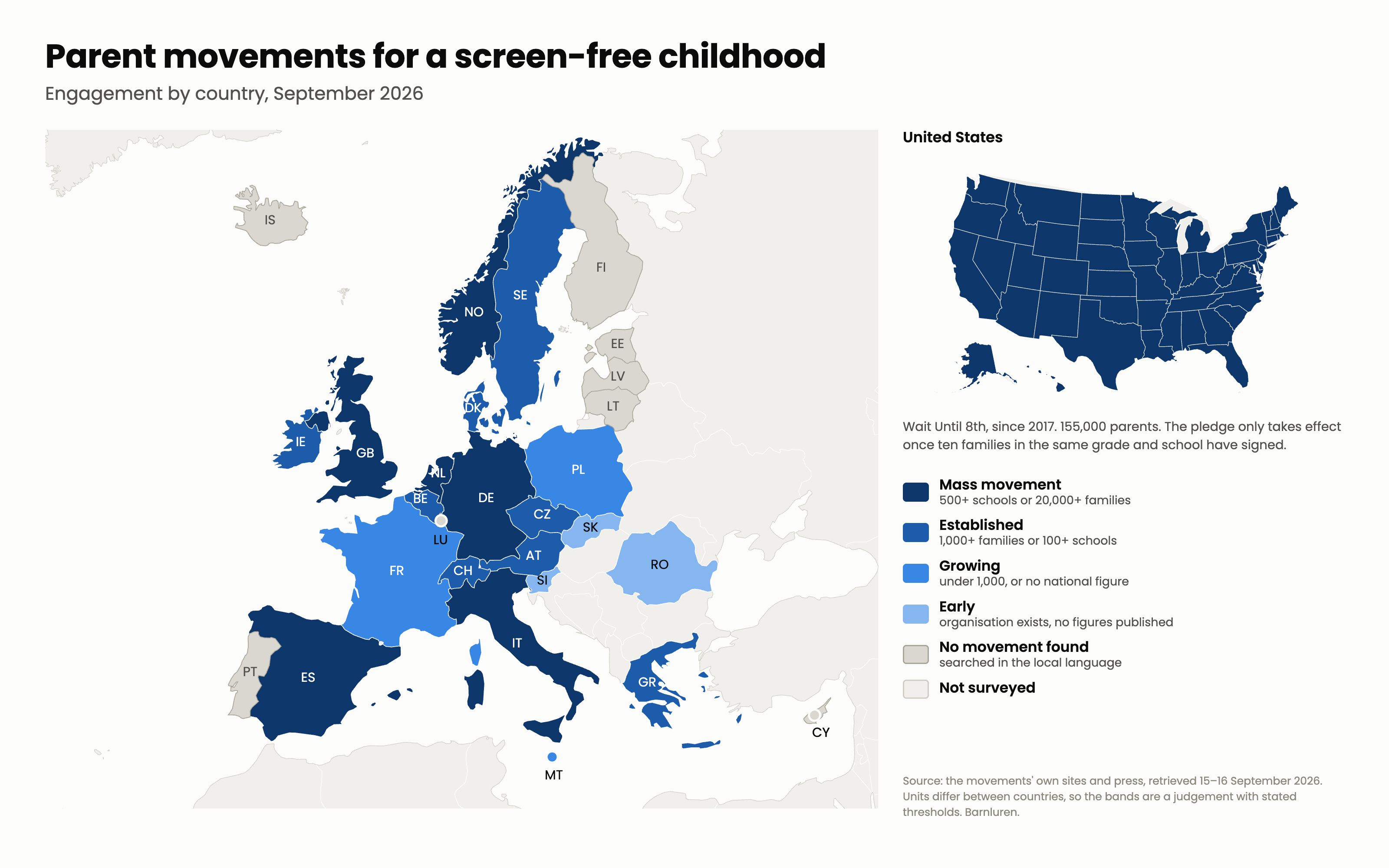
Darker blue means a larger movement. Units differ between countries, so the bands are our judgement, with the thresholds stated on the map. The tables below have the figures and the links.
The movements, country by country
Every movement below has an organisation of its own, not just a chat group. Figures were retrieved on 15 and 16 September 2026 from the movements' own sites where these exist, otherwise from the press, which is stated where it applies.
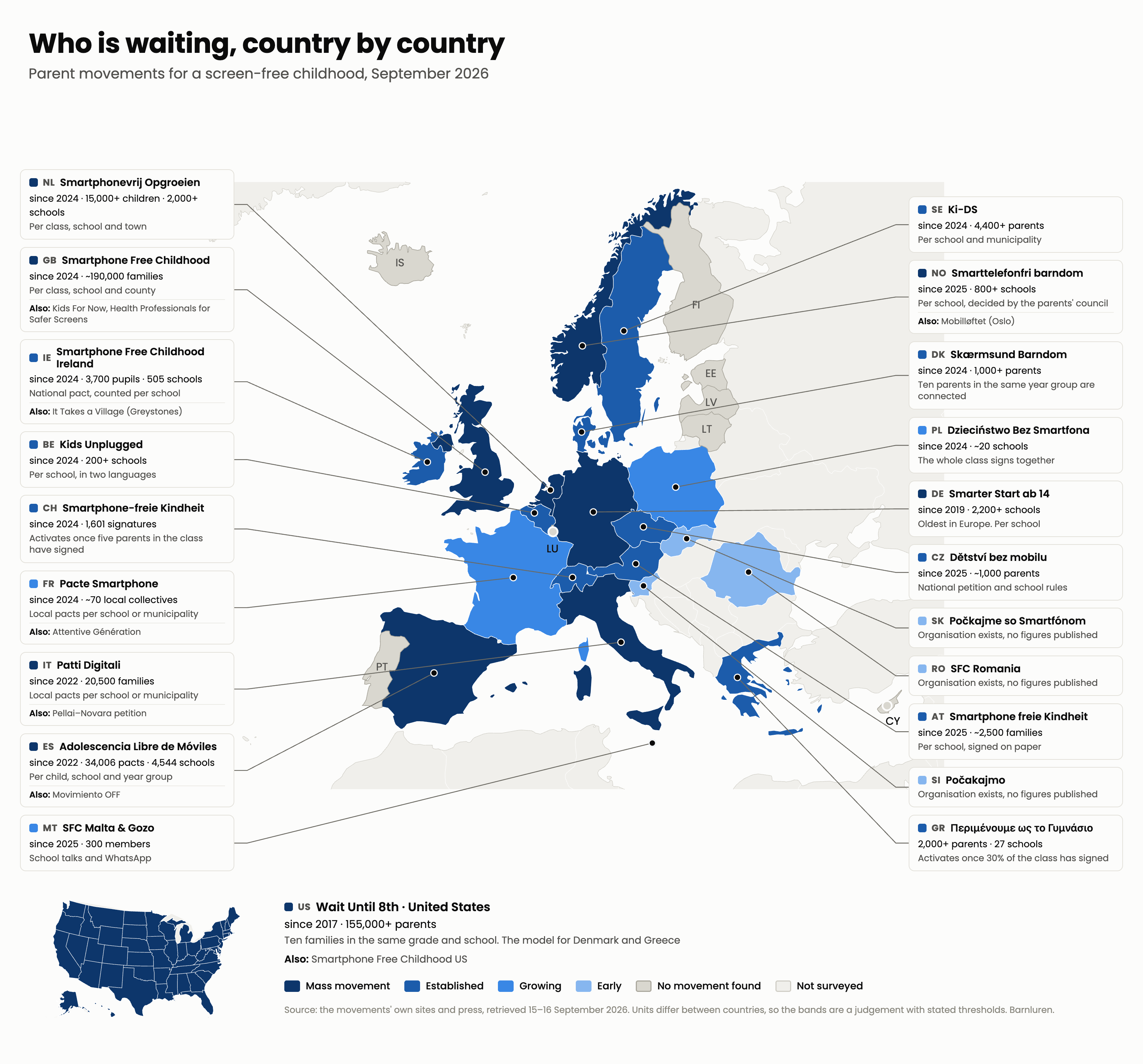
| Country | Movement | Started | Size | Threshold |
|---|---|---|---|---|
| 🇩🇪 Germany | Smarter Start ab 14 | Oct 2019, Hamburg | 2,200+ schools, 31,000 signatures on an open letter | per school |
| 🇮🇹 Italy | Patti Digitali also the Pellai–Novara petition (Change.org, Sept 2024, smartphones from 14) |
2022, Milano-Bicocca | 20,500 families, 240 local groups, 17 regions | per school or municipality |
| 🇪🇸 Spain | Adolescencia Libre de Móviles also Movimiento OFF (2024, a broader tech manifesto) |
Nov 2022, Poblenou | 34,006 pacts across 4,544 schools, 50 provinces | per child, school and year group |
| 🇮🇪 Ireland | Smartphone Free Childhood Ireland also It Takes a Village (Greystones, May 2023, all eight primary schools) |
2024 or 2025 | 3,700 pupils across 505 schools (Irish Times) | national pledge, counted per school |
| 🇬🇧 Britain | Smartphone Free Childhood also Kids For Now (Scotland 2022, the forerunner) and Health Professionals for Safer Screens (clinicians, 2024) |
Feb 2024 | 142,609 children, 13,750 schools, 190,000+ families | per class, school and county |
| 🇳🇱 Netherlands | Smartphonevrij Opgroeien | 2024 | 15,000 children across 2,000 schools (NOS, May 2025). Their own newer figures are higher | per class, school, town and province |
| 🇩🇰 Denmark | Skærmsund Barndom | spring 2024 | 1,000+ parents (DR) | ten parents in a year group |
| 🇸🇪 Sweden | Ki-DS | July 2024 | 4,400+ parents in pacts | per school and municipality |
| 🇨🇭 Switzerland | Smartphone-freie Kindheit | Oct 2024 | 1,601 signatures for the 2025/26 school year | five parents in a class |
| 🇫🇷 France | Pacte Smartphone also the umbrella Attentive Génération with some seventy local collectives |
spring 2024, Betton | no national figure published. ~70 collectives under the Attentive Génération umbrella | per school or municipality |
| 🇧🇪 Belgium | Kids Unplugged | Dec 2024, Brussels | 200+ schools on their own site, 2,000+ pacts in the press July 2026 | per school and region |
| 🇵🇱 Poland | Dzieciństwo Bez Smartfona | autumn 2024 | a pact counter exists, the figure would not render | per class, with school coordinators |
| 🇦🇹 Austria | Smartphone freie Kindheit | Jan 2025 | ~2,500 families, 1,164 experts on an open letter | per school, signed on paper |
| 🇳🇴 Norway | Smarttelefonfri barndom also Mobilløftet (a single school in Oslo) |
Feb 2025, Oslo and Bærum | 588 of 2,173 primary schools, 42% of children (NRK, Dec 2025) | per school, by parents' council resolution |
| 🇨🇿 Czechia | Dětství bez mobilu | early 2025 | ~1,000 parents (Dec 2025) | national appeal |
| 🇬🇷 Greece | Περιμένουμε ως το Γυμνάσιο | unknown | 2,000+ parents across 27 schools, mostly Athens | 30% of the class |
| 🇲🇹 Malta | SFC Malta and Gozo | late 2025 | 300 members on Gozo (Newsbook, Nov 2025) | school talks, not formal pacts |
| 🇸🇰 Slovakia | Počkajme so Smartfónom | unknown | no figure published | unknown |
| 🇸🇮 Slovenia | Počakajmo | unknown | no figure published | unknown |
| 🇷🇴 Romania | SFC Romania | unknown | no figure published | unknown |
| 🇺🇸 United States (for comparison) | Wait Until 8th also Smartphone Free Childhood US (no figures) |
2017, Austin | 155,000+ parents (own site) | 10 families per grade and school |
The movement is often described as British and then exported, but the timeline says otherwise. Germany's Smarter Start ab 14 began as early as autumn 2019, and parents in Italy, Spain and Ireland were also under way before Britain's Smartphone Free Childhood was founded in February 2024. Britain had a forerunner too: Kids For Now started in Scotland in 2022, when a father invited the other parents in his son's class to wait together.
And none of them was first. America's Wait Until 8th started in Austin in 2017 with exactly the threshold now used across half of Europe: the pledge only takes effect once ten families in the same grade and school have signed. Both the Danish and the Greek movements say they built on the American model.
A word on the claim that Smartphone Free Childhood has "chapters in 39 countries". Their own directory lists 46, but around twenty of those are nothing but a WhatsApp invitation with no name, site or organisation behind it. The British themselves write that the groups are independent and that they neither run, fund nor vet them. Several of the largest national movements have also dropped the SFC name: Sweden became Ki-DS, Denmark became Skærmsund Barndom, and Germany never used it.
They all count in schools
This is where it gets interesting. None of the movements counts in cities or in members. They count in schools and classes, and three of them have put a number on how many it takes.
In Switzerland parents are connected once five in the same class have signed. Five is, according to the movement, the point where it stops being an individual decision and becomes the class norm. In Denmark the line is ten parents in the same year group. In Greece the pledge does not activate at all until thirty percent of the families in the child's class have signed.
Those numbers say something about what the problem actually is. No parent lacks information about what screens do to children. That debate is settled in all twenty countries, and the authorities have landed on it. What is missing is not knowledge but coordination.
A parent who waits alone places a cost on their child: standing outside when the classmates move into the group chat. A parent who waits alongside twenty others places no cost at all. The pact is not a promise to the movement. It is a promise to the neighbour, and it only works if the neighbour signs it too.
That is why the class is the unit. Not the country, not the municipality, not the age group.
The legislation, country by country
A wave of legislation has swept Europe in parallel. But it is almost entirely about the school day. The rightmost column is the one that is nearly empty.
| Country | Phones in school | Official age for owning a phone | Social media |
|---|---|---|---|
| 🇸🇪 Sweden | national ban in compulsory school from 1 Aug 2026 | 13 (Public Health Agency, June 2026) | no limit |
| 🇫🇮 Finland | law restricting use during the school day since Aug 2025 | 13 (THL and the National Agency for Education, Jan 2026) | advised against under 13 |
| 🇩🇰 Denmark | phone-free folkeskole and after-school care in law from 2026/27 | 13 (the wellbeing commission, Feb 2025) | no limit |
| 🇳🇱 Netherlands | a national agreement, not a statute: secondary Jan 2024, primary 2024/25 | groep 8, roughly 11–12 (the government, June 2025). The lowest in Europe | 15 |
| 🇮🇪 Ireland | ban in all primary schools from June 2025, €9m for storage pouches. Secondary schools only have to restrict use | none, but the department's guidance from Nov 2023 teaches how to build voluntary agreements. Operators pledged in May 2024 not to sell to under-13s | digital age of consent 16 |
| 🇬🇧 Britain | school rules, no national ban | none | ban for under-16s announced June 2026, in force spring 2027 |
| 🇫🇷 France | banned by law since 3 Aug 2018 in schools and collèges, pause numérique generalised Sept 2025 | none adopted. The 2024 expert commission proposed 13 | digital majority 15 since 2023, under-15 ban adopted July 2026 |
| 🇩🇪 Germany | a state matter, eight Länder have bans (epd, Apr 2026) | no federal position | expert commission proposes 13 |
| 🇦🇹 Austria | national ban since 1 May 2025 up to and including grade 8 | none | 14 today, bill March 2026 |
| 🇨🇭 Switzerland | cantonal, earliest Vaud 2019 | none. Pro Juventute says 12–13 | federal report expected 2027 |
| 🇧🇪 Belgium | Flanders 1 Sept 2025, Wallonia-Brussels decree 13 March 2025 | none | no limit |
| 🇪🇸 Spain | all 17 regions restrict | none. Expert report to the government: analogue phone until 16 | a bill would raise it to 16, before the Congreso |
| 🇮🇹 Italy | circular of June 2025 extends the ban to upper secondary, the whole school day | none. The paediatric society SIP says 13 | 14 today, a bill proposes 15 |
| 🇵🇹 Portugal | years 1–6 from Aug 2025, extended to years 7–9 from 1 Jan 2027 | none | no limit |
| 🇬🇷 Greece | lower and upper secondary since 2024/25, suspension as a penalty | none | under-15 ban announced, planned for 1 Jan 2027, with state age verification |
| 🇳🇴 Norway | a national recommendation Feb 2024, not a law. 96% of schools follow it | no age set. The Directorate of Health, Jan 2026: limit access | 15 announced |
| 🇮🇸 Iceland | national regulation signed 27 Aug 2026, the whole school day and after-school care | none | no limit |
| 🇵🇱 Poland | law from 1 Sept 2026, all primary schools and kindergartens | none | no limit |
| 🇨🇿 Czechia | school rules allowed from Jan 2026, a mandatory ban decided for Sept 2027 | none | no limit |
| 🇱🇺 Luxembourg | primary schools April 2025, secondary June 2025 | none, but the children's ombudsman advocates a safe phone without internet as a step before | 16 proposed |
| 🇨🇾 Cyprus | parliamentary decision 17 Oct 2024, secondary level | none | pushing for a common EU limit |
| 🇱🇻 Latvia | years 1–6 from 2025/26, extended to 1–9 in force June 2026 | none | no limit |
| 🇱🇹 Lithuania | law from 1 Sept 2026: every school must have its own rules | none | no limit |
| 🇪🇪 Estonia | a statutory duty to set principles since 1 Sept 2025, no ban | none | no limit |
| 🇺🇸 United States (for comparison) | a state matter, 38 states and DC require a ban or restriction, 29 of them bell to bell (June 2026) | no federal age | a state matter |
The EU is moving now too, and again it is about the screen. On 16 September 2026, European Commission President Ursula von der Leyen presented the EU Kids Act: no social media under 13 and no personal account under 15, with parent-managed accounts for 13 to 15-year-olds. The proposal has to be negotiated with member states and the European Parliament before it becomes law. It says nothing about the phone.
The parents say 14. The countries rarely say anything at all.
Put the two tables side by side and a pattern emerges.
The parent pacts land on 14 in Britain, Sweden, Germany, Austria, Switzerland and Belgium, on eighth grade in Denmark and the United States, on 13 in Italy and Greece, and on 16 in Spain.
The countries land either lower or nowhere. Only four countries in Europe have an official recommendation for when a child should own a phone: the Netherlands, Sweden, Finland and Denmark. The Netherlands is the lowest of the four: from the final year of primary school, at around eleven to twelve. The other three say 13. All twenty other countries regulate only the school day, which is a different question: a ban in the classroom says nothing about what the child has in their pocket on the way home.
That is unusual. Normally the regulation pushes and the citizens lag behind. Here it runs the other way: the parents who organise are asking for a higher limit than the state sets, in the cases where the state sets one at all.
The countries without a movement
Seven countries have school bans but no parent movement we could find: Finland, Portugal, Iceland, Luxembourg, Cyprus, Estonia, Latvia and Lithuania.
Finland is the most instructive exception. The question is driven entirely from above: THL and the National Agency for Education published the recommendations in January 2026, the Finnish Parents' League holds parents' evenings about them, and the law has restricted phones during the school day since August 2025. No pact, no school groups, no movement with a name.
Meanwhile something else happened in Finland this summer: on 30 June the national landline network was shut down for good. The last call made the news. A country that has just disconnected its fixed telephony is also a country where a family that wants to wait with the mobile has exactly one alternative fewer than before.
Portugal has a movement, but it campaigns on schools rather than the household pledge: Menos Ecrãs, Mais Vida, started in January 2024 by four mothers who are also teachers. Iceland has a template from the parents' federation Heimili og skóli that local groups fill in themselves, with no age limit.
The question no movement answers
All twenty movements are about waiting. None of them is about what the child does in the meantime, and that is the honest gap in the whole story.
Two countries have started to touch it, both from outside the movements themselves.
In Denmark the government reached an agreement in September 2025 with the telecom operators, Børns Vilkår, Red Barnet and the retail trade. The shops undertook to advise parents about alternatives to smartphones when a phone is bought for a child under 13. The state asked the market to recommend something else.
In Spain the parent movement's own campaign comercios amigos has led hundreds of shops in Navarre, Catalonia and municipalities around Madrid to let children call home free of charge from the shop's landline.
It is the same insight, expressed two ways: waiting creates a gap, and somebody has to fill it.
Why it matters to us
We build Barnluren for that gap. A landline at home, without a screen and without internet, where the child calls the contacts the parents have approved and two children with a Barnluren each call one another directly.
We are not part of any of the movements in this text. They campaign on a question. We sell a product, made from the same need: for children to stay in touch with family and friends, the way we could when we were growing up.
But the mechanism they have found is worth taking seriously even for someone who only wants to understand how a child's day works. It matters little whether a child has a phone at home if none of their friends does. That is why we have moved our own focus from individual households to classes, teams and courtyards. The movements got there first, and they got there by counting. The Swiss found their number, five parents in a class, through experience rather than theory.
Method and sources
The figure of 450,000 is a rounded sum of the movements' own numbers and should be read as an order of magnitude. The movements count different things, families, parents or children, and Britain (about 190,000 families) and the United States (155,000 parents) make up most of it. German signatures and Norwegian schools are not included.
Mapped on 15 and 16 September 2026 through searches in English, French, Dutch, German, Italian, Portuguese, Greek, Norwegian, Icelandic, Polish, Czech, Latvian and Lithuanian. The primary source is the movement's own site where one exists, otherwise the press, which is stated in the table where it applies.
Where sources contradict each other we have taken the independent figure and said so: Norway is given with NRK's count rather than the movement's own, the Netherlands with NOS's verification from May 2025 rather than the higher in-house figures. The British and Belgian numbers diverge between the movements' own pages and the press, and anyone citing them should always give the date and the page.
Every link in the tables goes to the source for the item beside it. School bans in Germany differ between states and are given here only as a count, because three reputable sources disagree on dates and scope.